
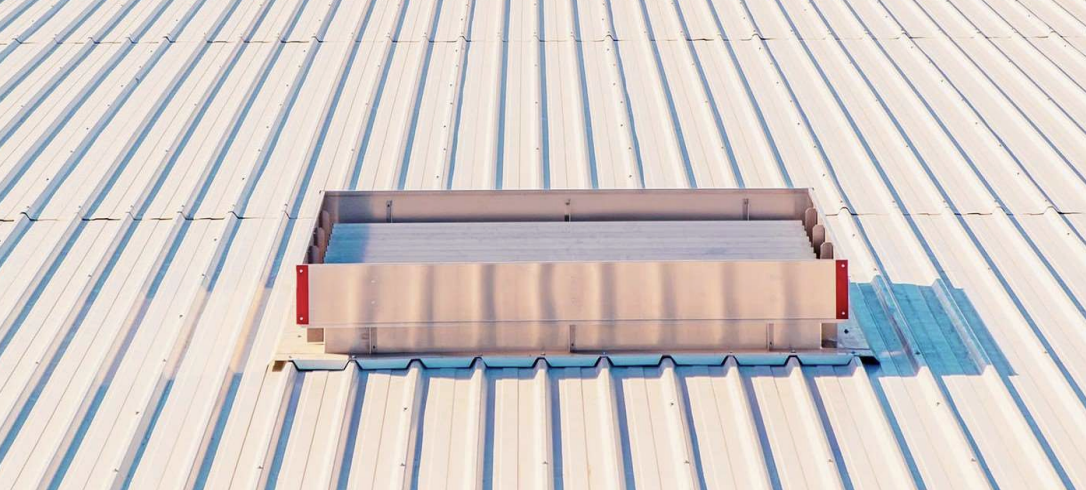
What Is Natural Smoke Ventilation?
Natural smoke ventilation systems are purpose-designed openings within the roof or façade that automatically activate during a fire to release smoke and heat from a building.
They operate on a simple principle: Hot smoke rises.
When activated, ventilators open at high level, allowing smoke to escape. This helps to:
- Maintain tenable conditions for occupants
- Support safe evacuation
- Enable fire brigade intervention
- Reduce heat build-up
- Limit smoke damage to the building
While fire is often localised, smoke can spread rapidly and cause significant damage.
Unlike mechanical systems, natural smoke ventilation does not rely on extraction fans. Instead, it uses buoyancy and aerodynamic design to move smoke through engineered openings.
These are not simple roof hatches, but engineered life safety systems tested to recognised standards, including AS2665 and EN12101-2, both delivering comparable, reliable performance.
More Than Fire Safety: Dual-Purpose Performance
A key advantage of natural smoke ventilation systems is their ability to deliver day-to-day building performance benefits, not just emergency response.
These systems can also provide:
- Natural heat ventilation to reduce reliance on air conditioning
- Passive cooling to improve occupant comfort
- Integration with HVAC systems to reduce operating costs
- Natural daylight through skylight-style designs
This dual functionality is a significant differentiator. As outlined in the reference material, natural ventilation can work alongside mechanical systems to reduce overall energy demand, supporting broader sustainability objectives.
How Do They Actually Work?
From a technical perspective, the effectiveness of a smoke vent system is determined by its ability to move air efficiently.
This is not just about opening size, it’s about aerodynamic performance.
Vent sizing considers:
- Geometric free area (Ag): the clear opening area
- Aerodynamic free area (Aw): the effective smoke extraction capacity
- Discharge coefficient (Cv): efficiency of airflow through the vent
Put simply: The larger and more aerodynamically efficient the vent, the more smoke it can remove.
Different vent types (e.g. flap vs louvre) will have different performance characteristics, which is why system selection must align with the specific building design and fire strategy.
Where Are Natural Smoke Vents Typically Used?
Natural smoke ventilation is particularly effective in buildings with large volumes or open spaces.
Common applications include:
- Warehouses and industrial facilities
- Atria and large retail environments
- Shopping centres
- Corridors and circulation spaces
- Community halls and theatres
These environments often involve:
- Large occupant loads
- Extended evacuation times
- High smoke production potential
In these cases, venting smoke at high level plays a critical role in maintaining safe conditions.
Why Is There Resistance in New Zealand?
While natural smoke ventilation is widely adopted in Europe, it is less commonly specified in New Zealand. This often leads to hesitation during design.
Common concerns include:
- “Mechanical systems already work well”
- Perceived complexity in compliance pathways
- Limited local familiarity
- Concerns around weather performance
These are all valid considerations. However, they are often focused on installation-stage challenges, rather than whole-of-life performance.
Mechanical systems typically involve:
- Greater electrical and control infrastructure
- Higher system complexity
- Increased servicing frequency
- Ongoing operational costs
In contrast, natural systems generally offer:
- Simpler operation (electric or pneumatic actuation)
- Fewer moving components
- Lower maintenance intensity
- Reduced long-term cost burden
When lifecycle performance is considered, the comparison becomes far more balanced.
What Europe Is Doing Differently
Across Europe, natural smoke ventilation systems are a standard design approach rather than an alternative.
This is driven by:
- Strong alignment with passive design principles
- Established certification frameworks (EN12101-2)
- Integration of ventilation and daylight into façade and roof design
- Greater emphasis on lifecycle and operational efficiency
These systems are not new or experimental, they are mature, well-tested solutions.
New Zealand is not behind on capability, simply earlier in the adoption curve.
Mechanical vs Natural: A Balanced Perspective
Natural smoke ventilation systems are not a replacement for mechanical systems in every scenario.
Both have a role. However, natural systems can offer clear advantages in the right applications:
- Reduced mechanical complexity
- Lower servicing requirements
- Seamless architectural integration
- Access to natural light and ventilation
- Strong alignment with sustainability targets
The key question is not: “Which system is better?”
But rather: “Which system is most appropriate for this building, this design, and this fire strategy?”
Let’s Continue the Conversation
Natural smoke ventilation systems are proven globally, yet remain underutilised in the New Zealand market.
As building design continues to evolve, particularly with the rise of sustainable and low-energy architecture, there is a growing opportunity to rethink how smoke management is approached.
We’re interested in your perspective.
- Have you specified natural smoke ventilation systems before?
- What challenges or concerns have you encountered?
Open discussion is how our industry evolves and at Smoke Control, we’re always ready to support that conversation with practical, performance-driven solutions.